
Resonant: speech models made of oscillators, not attention.
A coupled-oscillator network is a population of rhythmic units that pull each other toward phase agreement. Wire them onto a geometric structure with a coupling function and drive them with sound, and the field’s collective state becomes a representation of that sound. The physics does the transducing, and what you read out is the network’s own response to the input.
The idea is old
It runs from Huygens noticing in 1665 that two pendulum clocks on one beam fall into step, through the Hopf model of the cochlea (like your inner ear), reservoir computing that acts like a ripple in a pond, and Mead’s case for letting physics do the computing directly because it's more efficient than our von Neumann computers. What is new is that three fields have arrived at the same dynamics from different directions: Physics now describes synchronization regimes that exhibit computational properties rather than mere order. Neuroscience has identified the neuron as a complex chemical and physical system with functional oscillatory properties. Machine learning has recently produced oscillator architectures that are effective at classification, image generation and path navigation, with evidence suggesting that oscillatory neural networks can be trained, learn, remember and reason. Suggesting that oscillation and fluid dynamics are a fundamental property of the universe, and maybe intelligence.
That convergence is the motivation here. My working hypothesis is that a substrate whose native operations are resonance and entrainment (like the oscillators in the guide) more closely resembles the biological neurons that evolution refined to sense and learn from signals in the physical world, and that a trainable model built from those dynamics would make questions about learning, forgetting and rhythm disruption addressable in simulation.
Why speech
While I believe that oscillator models may be generalizable to other domains, and this theory is gaining support due to work by other researchers, speech is the natural place to explore this idea, because speech is oscillation at every scale: prosody near 1 Hz, syllable rhythm at 4–8 Hz, phone transitions at 10–40 Hz, pitch and formants from 100 Hz to several kHz. An oscillator field is a frequency-selective medium with intrinsic timescales, locking behaviour and spatial wave modes, which is the representational vocabulary that structure would seem to want.
The core
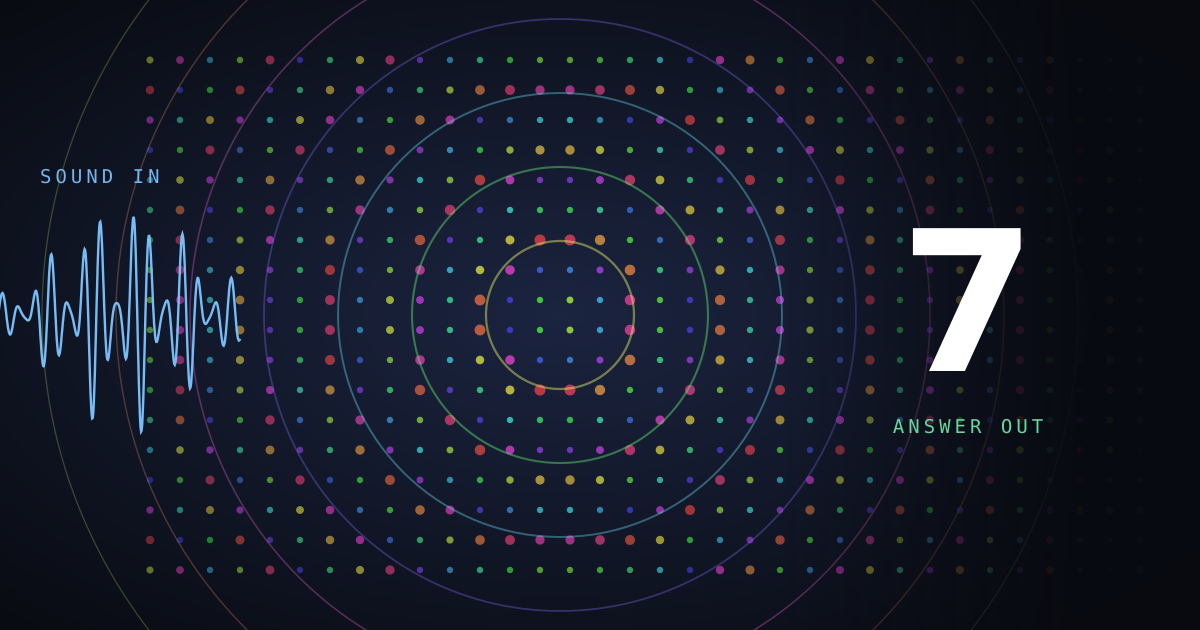
Project Resonant is the exploration of this idea. Its core is a grid of Kuramoto oscillators on a torus. Audio enters as a driving force, the oscillators pull each other toward agreement, and the readout is simply where every oscillator sits on its circle and how fast it is turning.
Because the coupling is a circular convolution, one step costs a single FFT, and the phase field doubles as a fixed-size streaming memory, with no cache that grows with the length of what you said. The model in the interactive guide is roughly 2,000 parameters and classifies spoken digits with incredible accuracy, without training and with even the most basic linear readout method. There is more to come as I have already begun training more complex models.
Learn more
Part 1: How a machine hears a number
The interactive guide: walking you through how your ear hears, how speech models work, followed by the new untrained 2,000 parameter oscillator model running live in your browser on real spoken digits.
Read the guidePart 2: Does the physics do the work?
The follow-up: what an untrained network of coupled oscillators adds to spoken-digit recognition, how a 6,353-run study tested it against its own input, simpler memories and trained networks, and every model running live in your browser.
Read the articleThe research
Two papers so far: a survey of oscillator networks in machine learning, and a study of 6,353 runs measuring what an untrained oscillator network adds to spoken-digit recognition, against its baselines and ablations. Each ships with the code and the raw per-run data behind its numbers.
Read the papers